Fleetstock Academy
Modern Industrial Technologies Series
Topic No. 0010
A plan of measures against non-conformities occurring in the production process
Prepared by: Fleetstock engineers
Published by: Fleetstock Academy
Version: 1.0
Preface
Non-conformities occurring in the production process are one of the main risk factors that directly affect product quality, process stability and overall efficiency of the enterprise. Non-conformities mean deviations from technological norms, quality standards or planned production parameters. Therefore, the development and implementation of a systematic plan of measures against non-conformities is important for the sustainable and safe management of production.
Goals and objectives
Goal
To form a systematic plan of measures for the timely identification of non-conformities occurring in the production process, their causes analysis, elimination and prevention of recurrence.
Tasks
To explain the methods of identifying non-conformities;
Indicate the rules for isolating a non-conforming product and process;
Analyze the root causes of non-conformity;
Identify the stages of developing and implementing corrective actions;
Assess the importance of preventive measures;
Describe the mechanism for monitoring and evaluating results;
Systematize the documentation and reporting process.
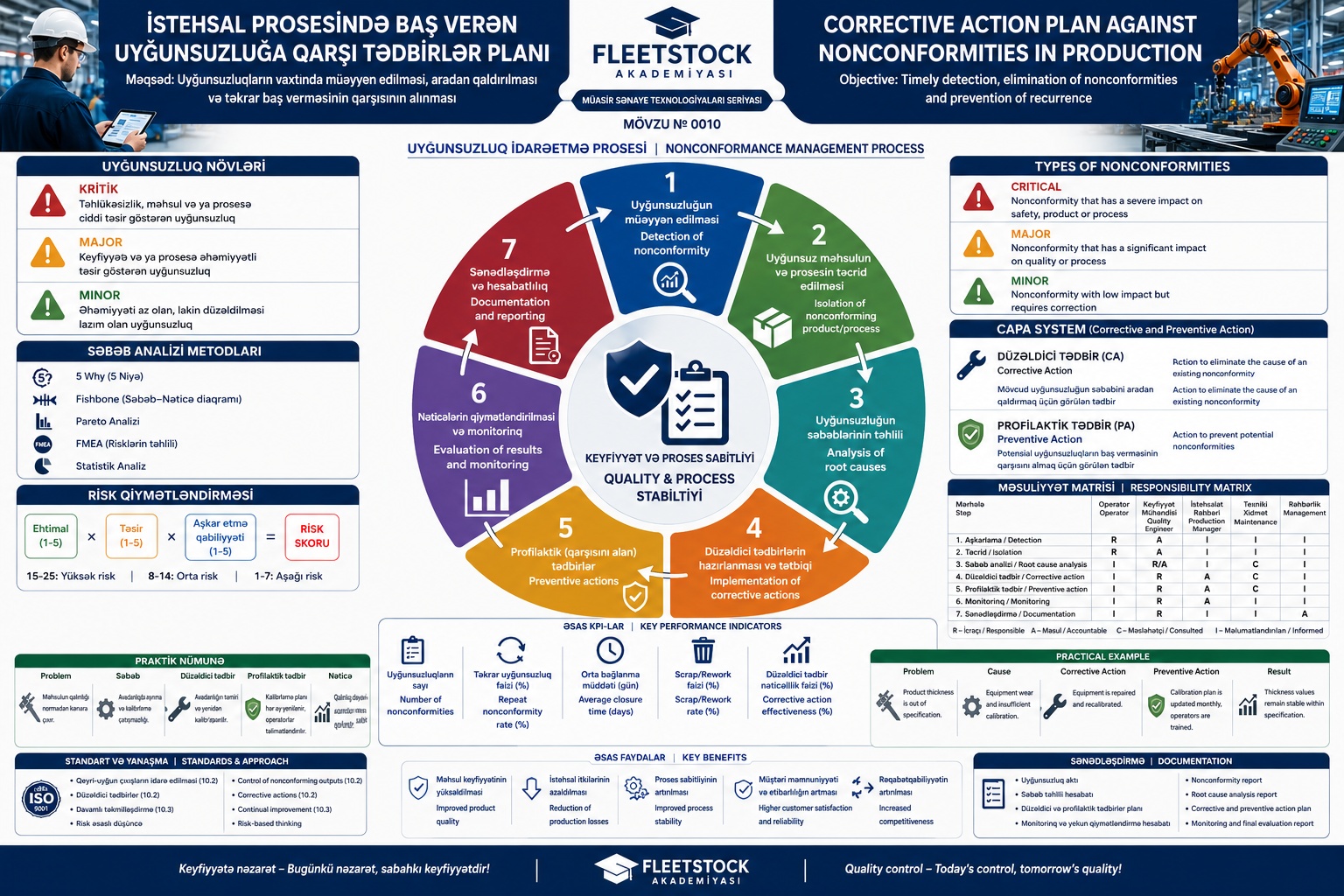
1. Identification of non-conformity
The first stage of the plan of measures against non-conformity is its timely detection. This process is carried out in the following ways:
Continuous monitoring of the production process;
Quality control checks;
Data collection through sensor and automated systems;
Observations and reports of personnel.
The detected non-conformity should be immediately registered and documented in a special journal or electronic system. This approach allows for a correct assessment of the scale of the problem and prompt decision-making.
2. Isolation of non-conforming product and process
After the non-conformity is identified, operational measures are taken to prevent its impact on the production flow:
the non-conforming product is separated from the production line;
special marking is made;
it is stored in an isolation zone to prevent mixing;
the process can be temporarily stopped or adjusted.
This stage prevents the release of a substandard product to the final stage or market and reduces the reputational risks of the enterprise.
3. Analysis of the causes of non-conformity
To effectively eliminate the non-conformity, it is important to identify its root causes. During the cause analysis, the following factors are examined:
equipment and technical malfunctions;
human factor and operator errors;
raw material quality indicators;
violation of technological parameters;
errors in the software and automation system.
At this stage, the “5 Why” method, cause-and-effect diagram and statistical analysis methods can be used. The purpose of the analysis is to identify not only the visible problem, but also the main source that caused it.
4. Preparation and application of corrective actions
After determining the causes, a corrective action plan is prepared to eliminate the nonconformity. These measures include:
repair and technical inspection of equipment;
calibration work;
readjustment of technological regimes;
additional training of personnel;
optimization of process control parameters.
Corrective actions should be specific, measurable and planned in terms of time. The person responsible for each measure, the implementation period and the expected result should be determined in advance.
5. Preventive (preventive) measures
Preventive measures are of particular importance to prevent the recurrence of nonconformity. These measures include:
updating standard operating procedures (SOP);
strengthening critical control points (CCP);
introduction of automated control systems;
preliminary risk assessment;
increasing the frequency of quality control.
Preventive measures increase long-term quality assurance and process stability. This approach serves to reduce not only existing inconsistencies in the enterprise, but also potential risks.
6. Evaluation of results and monitoring
Continuous monitoring is carried out to verify the effectiveness of the implemented measures:
re-measurement and testing;
comparative analysis of quality indicators;
process performance assessment;
internal audits.
Based on the monitoring results, additional improvement measures can be planned. This stage allows to assess the real impact of the measures and ensure the continuous development of the process.
7. Documentation and accountability
The final stage of the non-conformity action plan is the documentation of the entire process. These documents include:
non-conformity act;
root cause analysis report;
corrective and preventive action plan;
monitoring and final assessment report.
Proper documentation allows for the formation of an information history in the production process, optimization of decision-making and more effective management of future risks. At the same time, it plays the role of a reliable reference base in the internal audit and certification processes of the enterprise.
Scientific and practical result
The plan of measures against non-conformities occurring in the production process should be based on the principles of a systematic approach, operational intervention and continuous improvement. The correct implementation of this plan makes a significant contribution to improving product quality, reducing production losses and increasing the overall management efficiency of the enterprise.
Conclusion
The plan of measures against non-conformities is one of the main mechanisms for maintaining quality and managing risks in the production process. Timely identification of non-conformities, analysis of their causes, application of corrective and preventive measures ensures the stable operation of the enterprise and prevents repeated errors.
This approach serves not only to eliminate the current problem, but also to reduce the likelihood of similar non-conformities in the future. As a result, the enterprise has a more reliable, more flexible and more competitive production environment.
Contact Us
Mob: (+994 77) 311 56 66
Tel: (+994 12) 347 93 06
E-mail: info@fleetstock.az
Web: www.fleetstock.az
Fleetstock Group