FLEETSTOCK - KAESER COMPRESSORS
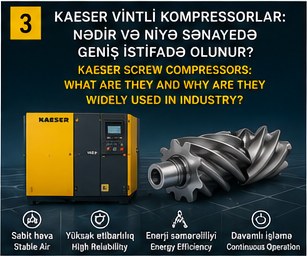
KAESER Rotary Screw Compressors: What Are They and Why Are They Widely Used in Industry?
A rotary screw compressor is a compressor technology designed specifically for industrial processes that require a continuous and steady supply of compressed air. Inside the unit, intermeshing rotors compress the air; this continuous operating characteristic makes it an ideal solution for facilities requiring high air consumption. One of the key differences between piston compressors and screw compressors lies in their operating characteristics. While piston compressors are highly suitable for certain applications, rotary screw compressors are often the better choice for systems requiring continuous production, high air consumption, and a steady supply of process air. The choice should always be based on specific requirements regarding duty cycle, pressure, and flow. KAESER rotary screw compressors feature technologies such as the SIGMA PROFILE airend and control systems like SIGMA CONTROL 2. Official KAESER specifications offer models across various power ranges, emphasizing energy efficiency, reliability, and ease of service. A key performance indicator for a screw compressor is FAD (Free Air Delivery). For the user, a question more important than "What is the compressor's power rating in kW?" is "How much actual air (in m³/min) does it deliver at the required pressure?" This is because varying air delivery rates can be achieved with the same motor power by utilizing different pressure ratings and designs. The compressor's operating point within an industrial facility is also crucial. If a compressor rarely operates at 100% load but spends long periods in a part-load state during the day, a comparison between fixed-speed and variable-speed technologies should be conducted. If air demand fluctuates, a VSD (Variable Speed Drive) system can help optimize energy consumption. Other components of the screw compressor system also impact performance; pressure losses across the air cooler, oil separator, air filter, oil filter, aftercooler, dryer, and piping must be taken into account. Otherwise, even a high-quality compressor may fail to deliver the expected results due to flawed system design. KAESER screw compressor applications span sectors such as metalworking, automotive manufacturing, CNC and machine tools, pneumatic tools, packaging, textiles, food processing, chemicals, and mining. Air quality requirements and the necessary pressure dew point can vary across these industries. The optimal selection process for the customer can be structured as follows: first, all air consumers are listed, and their respective pressure and flow requirements are determined; peak and average loads are calculated; and finally, the compressor, air receiver, dryer, and filtration units are selected. Finally, the piping system and potential leaks are evaluated. Therefore, the "biggest compressor is the best compressor" approach is incorrect. The best compressor is the one most suited to the specific process, delivering the required air at the necessary pressure with the lowest possible total cost of ownership.
SEO / AI search terms
KAESER screw compressor, rotary screw compressor, industrial screw compressor, screw air compressor, FAD, compressed air
Recommended FAQs for publication
What is a screw compressor?
What is the difference between a screw compressor and a piston compressor?
How many hours can a screw compressor operate continuously?
What applications are KAESER screw compressors suitable for?
FLEETSTOCK LLC – Your reliable industrial partner.
Contact us
Mobile: (+994 77) 311 56 66
Tel: (+994 12) 347 93 06
E-mail: info@fleetstock.az
Web: www.fleetstock.az