FLEETSTOCK - KAESER COMPRESSORS
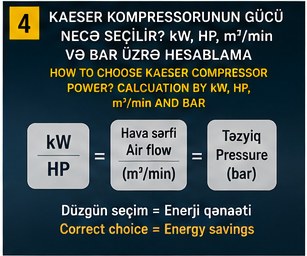
How to Select the Right KAESER Compressor Power? Calculations Based on kW, HP, m³/min, and bar
One of the most common mistakes when selecting a compressor is basing the decision solely on the electric motor's power rating. A customer might say, "I need a 30 kW compressor," without specifying the required airflow (m³/min) or pressure (bar) behind that choice. A professional selection process requires evaluating kW, HP, FAD (Free Air Delivery), pressure, specific power, and the load profile together.
The first indicator is air consumption. For instance, if the total requirement for all pneumatic equipment on a production line is 8 m³/min, simply looking at a nominal rating of 8 m³/min is insufficient. Factors such as peak consumption, leaks, future expansion, and the simultaneous operation of equipment must be taken into account.
The second indicator is pressure. 6 bar, 7 bar, 8 bar, and 10 bar are not the same. As the compressor's pressure rating increases, the energy consumed to produce compressed air changes. Therefore, claiming that a "10-bar compressor is better" is incorrect; the 10-bar class should only be selected if the user actually requires 10 bar of pressure.
The third factor is FAD. FAD (Free Air Delivery) is a key indicator representing the actual air output available for use. When comparing catalog specifications from different manufacturers, it is crucial to verify that the measurement conditions and pressure points are identical.
The fourth consideration is the operating profile. For instance, if a compressor runs for 8 hours a day but the air demand consists of 40% medium load, 20% peak load, and the remainder low load, an economic comparison between variable-speed and fixed-speed options should be conducted.
The fifth factor is ambient conditions. In Azerbaijan, high summer temperatures can impact compressor room cooling requirements and overall performance. Therefore, factors such as ambient temperature, ventilation, cooler maintenance, and the extraction of hot air from the room must be taken into account during the design phase.
The sixth factor is air quality. Food and pharmaceutical processes may require oil-free compression, specialized filtration, and a low dew point, whereas standard workshop air might be adequately served by a different system.
Consider a simple example: a factory requiring 10 m³/min at 7 bar. First, the actual consumption of all end-users is measured. Next, calculations are performed for receiver volume, pressure drops across dryers and filters, pipeline losses, and leakage rates. Finally, the compressor's actual operating point is determined. KAESER offers various series with different power, pressure, and control options. Therefore, model selection should be based on a technical performance chart rather than just a "kW chart."
FLEETSTOCK can assist in formulating technical specifications based on the customer's required air consumption, pressure, and operating mode.
FLEETSTOCK LLC – Your reliable industrial partner.
Contact us
Mobile: (+994 77) 311 56 66
Tel: (+994 12) 347 93 06
E-mail: info@fleetstock.az
Web: www.fleetstock.az