Fleetstock Academy
Integration of SCADA and ERP systems in production resource planning
Topic No. 0014
The role of artificial intelligence in production processes
Prepared by: Fleetstock engineers
Publication: Fleetstock Academy
Version: 1.0
1️⃣ What is SCADA?
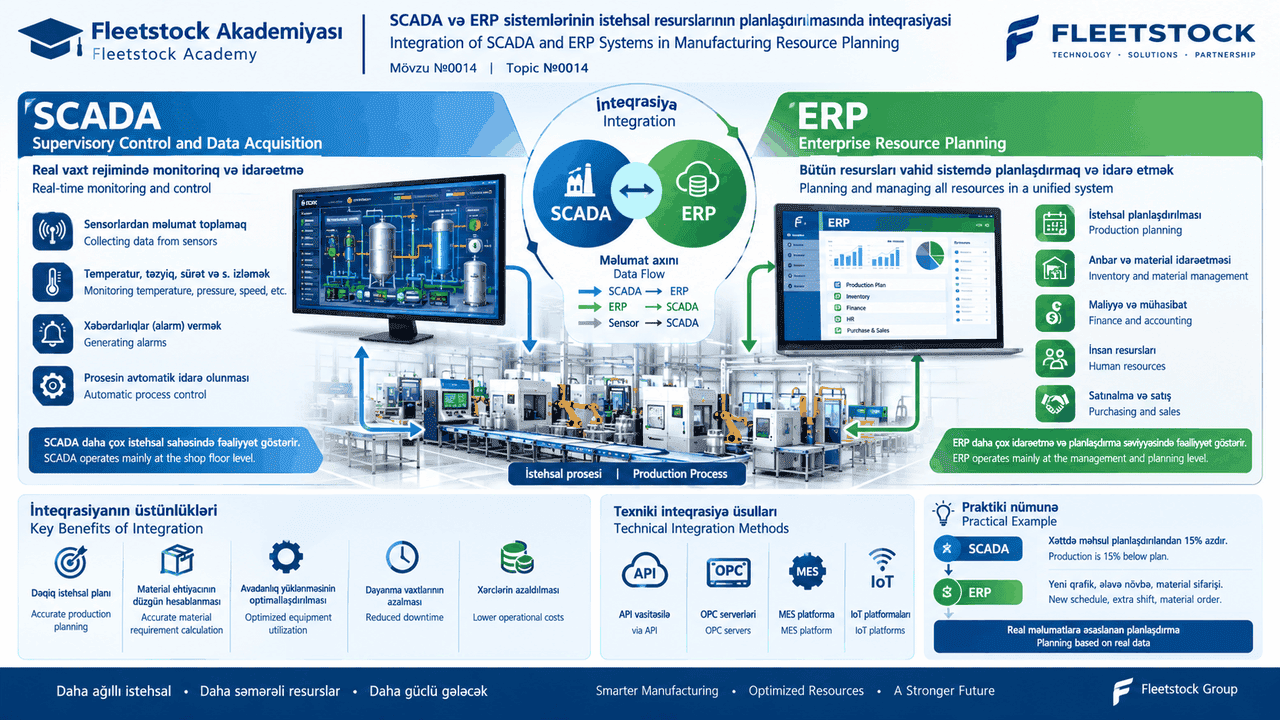
SCADA (Supervisory Control and Data Acquisition) is a system used for the real-time monitoring and control of production processes.
Key functions:
Collecting data from equipment (sensors, PLCs)
Monitoring parameters such as temperature, pressure, speed, etc.
Issuing alerts (alarms) to the operator
Automatic process control
SCADA operates primarily at the production floor level.
2️⃣ What is ERP?
ERP (Enterprise Resource Planning) is software that plans and manages an enterprise's resources within a unified system.
Areas covered:
Production planning
Warehouse and material management
Finance and accounting
Human resources
Procurement and sales
ERP operates primarily at the management and planning level. 3️⃣ The essence of SCADA and ERP integration
The integration of SCADA and ERP systems involves the automatic transfer of information from the production floor (real-time data) to the planning and management system.
Information flow:
Sensor → SCADA → Real-time production metrics
SCADA → ERP → Planning and reporting
ERP → SCADA → Production orders and standards
4️⃣ Impact on production resource planning
Integration yields the following benefits:
✅ 1. Accurate production planning
ERP receives real-time production capacity data from SCADA and structures the plan accordingly.
✅ 2. Precise calculation of material requirements
Actual raw material consumption is automatically transmitted to ERP → MRP (Material Requirements Planning) operates more accurately.
✅ 3. Optimization of equipment utilization
SCADA indicates whether equipment is idle or in use → ERP ensures proper resource allocation.
✅ 4. Reduction of downtime
Malfunctions are detected in SCADA → The maintenance schedule in ERP is automatically updated. ✅ 5. Cost reduction
Reduction of excess inventory
Minimization of production delays
More efficient use of energy and labor resources
5️⃣ Technical integration methods
Data transfer via API
OPC servers
MES (Manufacturing Execution System) as an intermediary platform
IoT platforms
6️⃣ Practical example
For instance:
SCADA indicates that production output on the line is 15% lower than planned.
Taking this into account, the ERP system:
Generates a new production schedule
Schedules an additional shift
Updates material orders
In this scenario, planning is based on real data rather than estimates.
7️⃣ Conclusion
Integration of SCADA and ERP systems enables:
🔹 Planning based on real-time data
🔹 Resource optimization
🔹 Increased production efficiency
🔹 Risk reduction
🔹 A key element of digital transformation
Contact us
Mobile: (+994 77) 311 56 66
Tel: (+994 12) 347 93 06
E-mail: info@fleetstock.az
Web: www.fleetstock.az
Fleetstock Group